
Reviewed · VIK TOURS
Easy Hike on Sólheimajökull Glacier
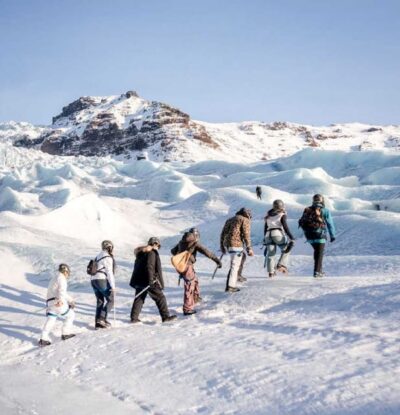
Sólheimajökull is not just a wall of blue ice viewed from a roadside pullout. On this easy three-hour glacier hike, you walk onto the ice, pass through bands of volcanic ash, peer into crevasses and moulins, and may drink from a stream of fresh glacial meltwater. The real surprise is how much a short outing can show you.
I like two things here: the small group size, capped at 12, and the careful route planning that lets guides adjust the walk to the group. I also like that the guides, including Karolina and Łukasz, explain the forces changing the glacier instead of treating it as a pretty photo backdrop.
The main consideration is gear. Crampons, a helmet, harness, and ice axe are included, but hiking shoes and rain gear are not. You need sturdy footwear and clothing that can handle Icelandic weather, and the outing can be canceled if conditions are poor.
Key points about the Sólheimajökull ice walk
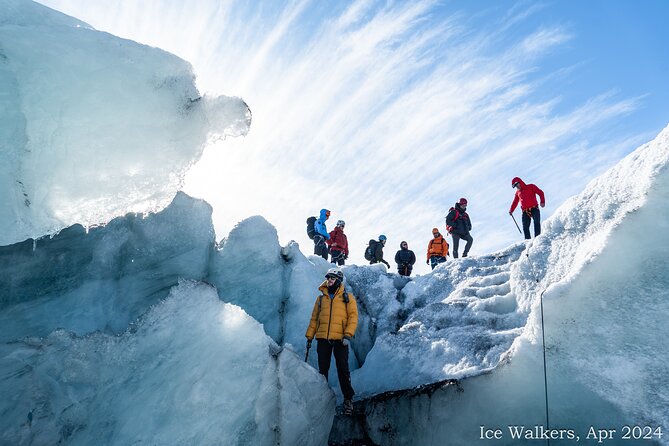
- A real walk on the glacier: You spend about two hours on the ice, not just at the viewpoint.
- A manageable route: The guides describe this as an easy hike and can select routes suited to a mixed group.
- Small groups: A maximum of 12 people gives the guide room to monitor pace and safety.
- Volcanic ash in the ice: Dark bands and piles of ash show how Iceland’s volcanoes have shaped the glacier.
- Useful glacier instruction: You learn how to use crampons, an ice axe, helmet, and harness before stepping onto the ice.
- A changing natural site: Guides explain why some parts of the glacier may become inaccessible as the ice retreats.
Why this short glacier walk is worth your time
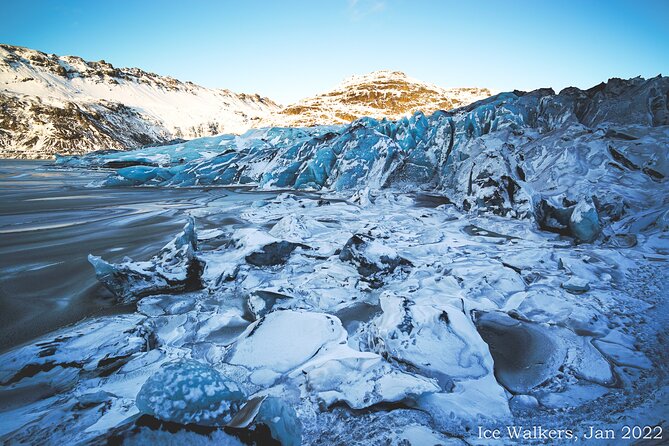
Sólheimajökull is an outlet glacier of Iceland’s larger ice cap, and it reaches down toward the coast in southern Iceland. You do not need mountaineering experience for this outing. The route is chosen for a general group, with technical sections reduced or avoided as needed.
That makes the experience a good fit if you want direct contact with Iceland’s ice without signing up for a demanding climbing day. You still get the feel of a proper glacier trip: specialized equipment, a guide-led route, safety instruction, and changing ice under your feet.
The price is about $95 per person. I consider that fair value for roughly three hours, since the cost covers the guide, equipment, group management, route choices, and safety work that you do not see. You are not simply paying for a walk. You are paying for someone who knows where the ice is safe enough to enter on that particular day.
The group limit matters here. A guide trying to keep track of a large crowd on moving ice would have less time for questions and photos. With no more than 12 people, you should have a better chance to hear the explanations and stay close enough for instructions.
The tour is offered in English. Confirmation is provided when you book, and the activity begins and ends at the Sólheimajökull glacier parking lot.
More Hiking Tours in Vik
- Skaftafell: Ice Cave Tour and Glacier Hike
★ 4.5 · 1,746 reviews - Sólheimajökull: Guided Glacier Hike
★ 4.7 · 1,123 reviews - Sólheimajökull Glacier Hike – Adventure in a Small Group
★ 5.0 · 799 reviews
Reaching the glacier from the parking lot
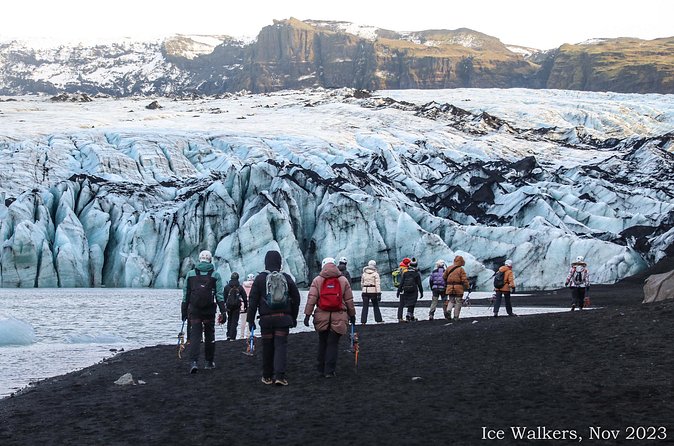
You meet at the Sólheimajökull glacier parking lot, listed as 221, 871, Iceland. The first part of the outing is not on the ice. You collect your equipment and walk for about 20 minutes toward the glacier terminus.
That approach is useful rather than wasted time. It gives you a gradual introduction to the area and lets the guide explain how glaciers form, move, and change. You also get time to ask basic questions before the more focused safety talk begins.
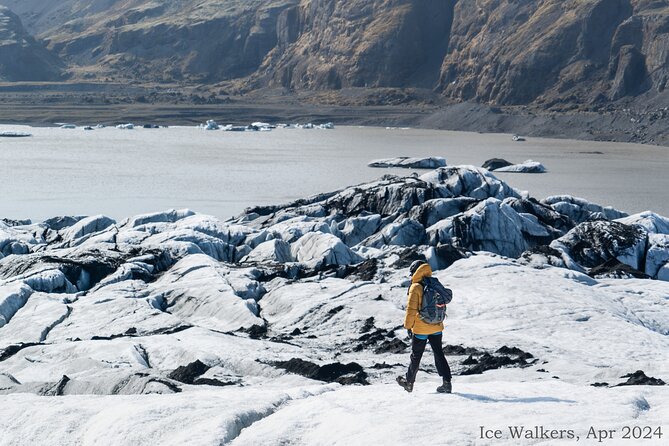
Bring your attention to the ground and the changing colors as you walk. The route leads through a stark setting shaped by ice and volcanic material. The dark ash is especially important because it shows that Iceland’s glaciers are not isolated from the country’s volcanic activity.
The 20-minute walk also means this is not a parking-lot-to-ice experience. You need to be comfortable walking from the meeting point to the glacier and back. The description says most people can participate, but you should still think about your own balance, footwear, and comfort on uneven ground.
Getting fitted with crampons and glacier gear
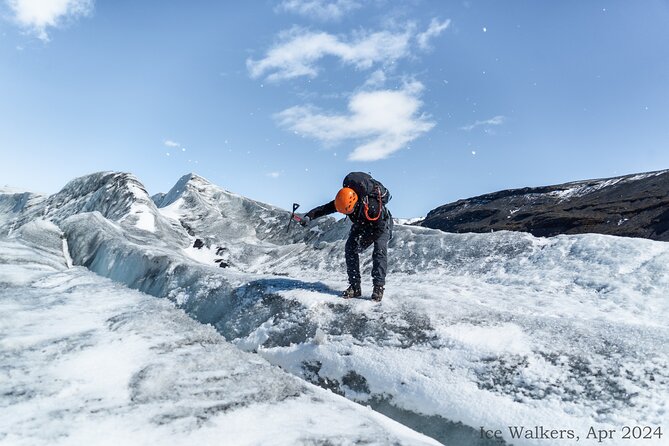
At the meeting point, the guide provides crampons, a helmet, a safety harness, and an ice axe. These are included in the price, so you do not need to bring your own glacier equipment.
The fitting stage is one of the most important parts of the tour. Crampons give you grip on the ice, while the helmet and harness are part of the glacier safety system. The ice axe is not a decorative prop. You will be shown how to use the gear before setting off.
Expect a proper briefing before you step onto the glacier. The guide explains safety rules and checks that the group understands how to move. That matters on a glacier because the surface can change from firm ice to rough, ash-covered ice and back again.
You need to supply your own hiking shoes and rain gear. The provided information does not specify a shoe model, so do not arrive in ordinary sneakers and assume the crampons will solve everything. You also need waterproof protection for the weather. Iceland can change quickly, and the tour requires suitable clothing for an exposed outdoor setting.
Walking through ice, ash, and blue openings
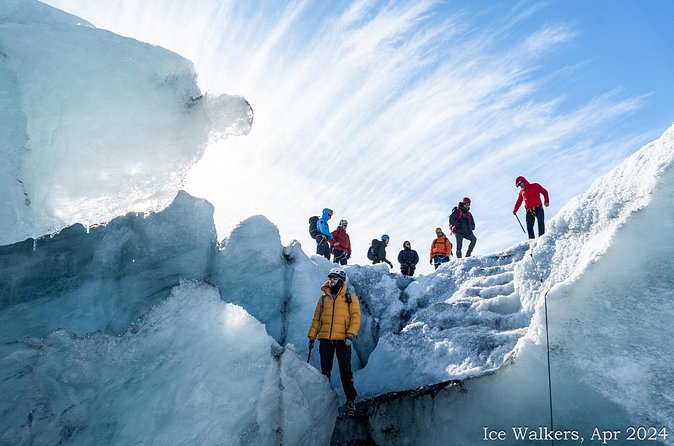
Once you reach the ice, the route leads through walls of ice and piles of volcanic ash toward the upper plateau. The experience is not limited to one scenic stop. You walk through a changing mix of textures and colors, with the guide pointing out details that are easy to miss on your own.
The ash gives the glacier a distinctly Icelandic character. You may see dark layers trapped in the ice, reminders of earlier volcanic eruptions and the long movement of the glacier. The contrast between black ash and pale or blue ice makes this one of the best parts of the outing for photography.
As the route gains ground, you get a wider view across the glacier. The tour allows time to stop, take pictures, and examine points of interest. The pace is not presented as a race to the top. That is good news if you want to listen, take photos, or simply get used to walking in crampons.
The word easy should still be read in context. This is an accessible glacier outing, not a flat nature path. You are walking on ice with equipment attached to your boots, and the surface may feel unfamiliar. Your guide chooses the route and can adjust it to the group, but you should be ready for a physical outdoor activity.
More Solheimajokull glacier trips:
- Solheimajokull Glacier 3-Hour Small-Group Hike
★ 5.0 · 501 reviews - Sólheimajökull Glacier Hike – Small Group Blue Ice Adventure
★ 5.0 · 497 reviews - Kayaking on the Sólheimajökull Glacier Lagoon
★ 5.0 · 421 reviews - Vik: Guided Glacier Hike on Sólheimajökull
★ 4.7 · 265 reviews
Crevasses, moulins, and the details you would miss
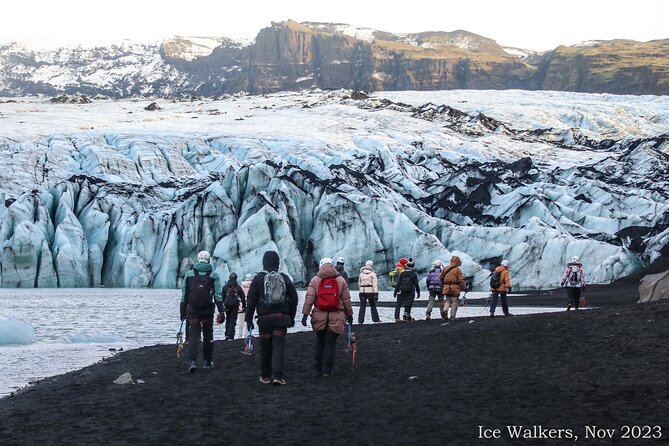
A major strength of a guided glacier walk is the close look at features that are difficult to interpret from a distance. You may see crevasses, which are cracks or breaks in the glacier, and moulins, where meltwater can travel down into the ice.
These features give the glacier a sense of motion and depth. A glacier is not a frozen slab. It bends, cracks, drains, and shifts as weather and gravity act on it. The guide’s job is to show you these details while keeping you away from unsafe areas.
Karolina has been praised for noticing small and subtle features that a visitor might walk past without seeing. That is exactly where a guide adds value. You may notice the big blue wall on your own, but an experienced guide can draw your eye to color changes, water channels, ash patterns, and the structure of the ice.
The guide also makes room for questions. If you are curious about how glaciers form or why the ice looks different from one section to the next, this is a better setting for answers than a roadside sign. You can ask while looking directly at the feature being discussed.
Drinking glacial meltwater when conditions allow
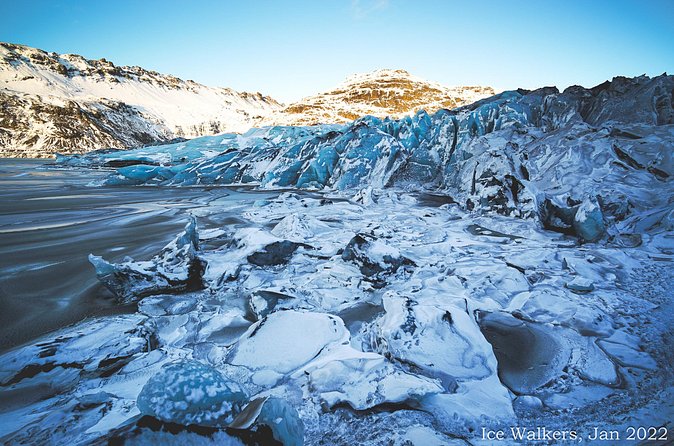
The outing may include a chance to drink from a stream of glacial meltwater. This is not guaranteed in every season. In the middle of winter, the water may be frozen, so the opportunity depends on conditions.
It is a small moment, but it connects the tour to the glacier in a memorable way. You are not just looking at ice. You are seeing meltwater emerge from it and learning how the glacier behaves in warmer conditions.
Do not treat this as the main reason to book. Crevasses, moulins, ash, and the walk itself are the core of the experience. Think of the water as a bonus that may be available on the day.
A guide-led experience built around safety
The strongest part of the operation is the attention given to safety and route choice. The guide checks equipment, teaches you how to use it, and explains the rules before you begin. On the ice, the route can be selected according to weather, glacier conditions, and how the group is managing.
That flexibility is particularly helpful for mixed parties. The outing may include people with different levels of fitness, from older adults to younger children. The guide can keep the pace together and choose a route that remains interesting without pushing people into technical terrain.
A mountaineer might find the route simple, and that is the point. The outing is designed to make glacier travel possible for people who are not climbers. The guide can still explain the technical side of the ice, but you are not expected to arrive with rope skills or glacier experience.
The maximum group size of 12 is another practical advantage. You should be able to stay within hearing range, and the guide has a more realistic chance of watching how everyone is moving. Still, a small group does not remove the need to follow instructions. Stay with the guide and do not wander toward an attractive crack or tunnel on your own.
Understanding a glacier that is changing fast
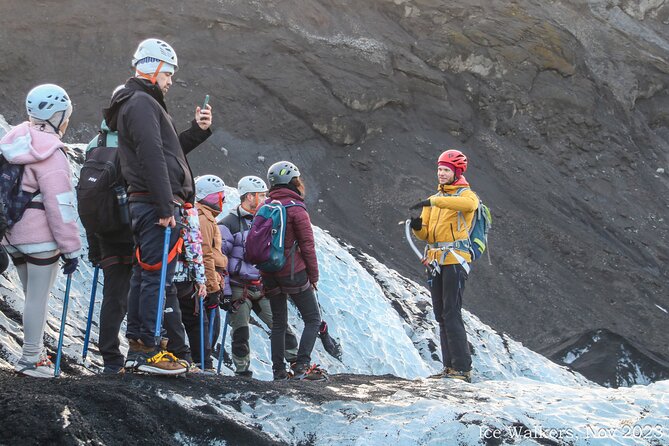
This walk has an important message beyond its scenery. The glacier is changing, and the route you use today may not remain available. One guide warned that a particular part could be inaccessible within two years. That is a reminder that glacier travel is also a chance to see a temporary part of Iceland.
You do not need a lecture to understand climate change when you are standing on ice that is visibly retreating. Guides such as Karolina and Łukasz can connect the physical features around you with the larger changes affecting Iceland’s glaciers.
That context gives the experience more weight. You get photographs, but you also gain a clearer sense of why the glacier matters and why a visit now cannot be taken for granted. The ice is not a permanent stage set.
I appreciate that this message can be delivered without turning the trip into a classroom. The best explanations happen while you are looking into a crevasse, following meltwater, or crossing an ash-streaked section of ice. The science stays tied to what you can see.
Is $95 a good value?
At $95, this is not the cheapest activity you can add to a southern Iceland itinerary. You can view glaciers from public roads and viewpoints without paying anything. But those stops do not put crampons on your boots or take you across the ice.
For the price, you receive the main safety equipment, an English-speaking guide, a roughly three-hour outing, and a route planned around current conditions. The guide’s preparation is part of the value. Glacier terrain changes, and selecting a suitable route requires more than following a marked trail.
I would choose this over a longer, more expensive glacier adventure if your main aim is to experience the ice without committing to a strenuous day. It is also a sensible option for a family or mixed-age group, provided everyone can manage the approach walk and the physical demands of walking in glacier gear.
The value is weaker if you only want a quick photo or if you already have substantial glacier skills and want a technical climb. For most first-time visitors, though, the combination of access, instruction, equipment, and time on the ice makes the price reasonable.
Who should book this ice walk?
You should consider it if you want a direct, guided introduction to glacier travel and have about three hours near Vík. It suits people who like nature with explanation, not just scenery, and it gives photographers time to work without turning the outing into a rushed march.
It also fits a mixed group. The route can be adapted, and most people can participate according to the provided information. Karolina’s patient pacing with a group that included a young child and seniors shows the kind of flexibility that can matter when not everyone has the same speed or confidence.
You should think twice if you lack suitable hiking shoes or rain gear, dislike exposed outdoor conditions, or want a completely effortless walk. The word easy does not mean risk-free or indoor comfortable.
Book ahead if your Iceland schedule is tight. The experience is commonly reserved well in advance, with an average booking lead time of 117 days. That figure suggests you should not assume you can wait until the day before and still find a place.
Cancellation is free up to 24 hours before the start time for a full refund. If poor weather forces a cancellation, you are offered another date or a full refund. Changes or cancellations made less than 24 hours before the start time are not accepted for a refund, and local time controls the cutoff.
Should you book the Sólheimajökull walk?
I would book this tour if you want a safe, manageable way to step onto a real Icelandic glacier. The best reasons are the small group limit, the careful equipment briefing, the chance to see crevasses and moulins, and the guides’ ability to explain both the beauty and the decline of the ice.
Bring proper hiking shoes and rain gear, allow time for the 20-minute walk to the terminus, and expect a genuine outdoor activity rather than a quick viewpoint stop. If that sounds like your kind of Iceland experience, $95 buys far more than a photograph of a glacier. It gives you a close look at a place that is changing while you are there.
FAQ
Where does the Sólheimajökull glacier hike begin?
The tour begins at the Sólheimajökull glacier parking lot, listed as 221, 871, Iceland.
Where does the activity end?
The activity ends back at the meeting point, the Sólheimajökull glacier parking lot.
How long does the glacier walk take?
The full activity lasts about three hours. The glacier portion is listed as two hours, with about a 20-minute walk to the glacier terminus.
What equipment is included?
Crampons, a helmet, a safety harness, and an ice axe are included.
Do I need to bring hiking shoes?
Yes. Hiking shoes are not included, so you need to bring your own suitable footwear.
Is rain gear provided?
No. Rain gear is not included, so you need to bring your own.
What language is the tour offered in?
The experience is offered in English.
Can the tour be canceled because of weather?
Yes. The experience requires good weather. If it is canceled because of poor weather, you can choose a different date or receive a full refund.
Just added around Vik
- Exclusive Ice Climbing Experience on Sólheimajökull★ 5.0 · 3 reviews
- Highland Snowmobiling Tour in Southern Iceland★ 5.0 · 3 reviews
- Private Ice Climbing on Sólheimajökull★ 5.0 · 3 reviews
- Þórsmörk Buggy Adventure Tour in Southern Iceland★ 5.0 · 4 reviews
- South Coast Including Vatnajökull National Park and Jökulsárlón Glacier Lagoon★ 4.0 · 4 reviews
- Hvolsvöllur: Private Thorsmork Guided Day Hike by Super Jeep★ 5.0 · 4 reviews
- Private Glacier Hike on Sólheimajökull★ 5.0 · 4 reviews
- Glacier Exploration Hike and Climb★ 5.0 · 5 reviews
Vik Tours, compared.
Jokulsarlon Glacier Lagoon Full-Day Guided Trip
Read our review →
South Coast Classic: Full-Day Tour from Reykjavik
Read our review →
Ice Cave by Katla Volcano Super Jeep Tour from Vik
Read our review →Browse the lists this tour appears in